
The Desert Inside You
On becoming, doubt, and the inner pilgrimage

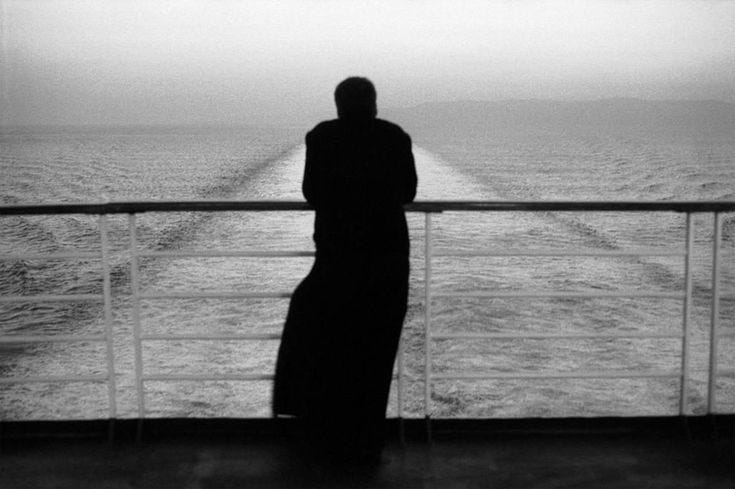
There comes a moment—often quiet, always terrifying—when you realize you cannot keep living the life you’re in.
No tragedy has occurred. No catastrophe has forced your hand. But something ancient stirs. A silence deep enough to echo. And suddenly, the things that once filled your days—the career, the parties, the plans—feel like costumes in a play you can no longer perform.
This is not a crisis. This is a beginning.
Søren Kierkegaard called it the sickness unto death. Not physical death, but the slow erosion of the self that occurs when we ignore the eternal within us. When we refuse to become who we were meant to be. “The greatest hazard of all,” he wrote, “losing one’s self, can occur very quietly in the world, as if it were nothing at all.”
And Hermann Hesse? He wrote entire novels around this moment. His characters—Siddhartha, Harry Haller, Emil Sinclair—each begin with a rupture. The world splits. The self is thrown into contradiction. The journey begins inward.
We are all these characters. And most of us are asleep.
Until the soul knocks.
The divine discomfort
You feel it in the in-between moments—after a meeting, before a meal, staring at your face in the bathroom mirror. Something is wrong. Not with the world. With you. And not wrong like broken. Wrong like unfinished.
Kierkegaard understood this discomfort not as pathology, but as proof of the divine. He believed the human self is a synthesis—a tension between the finite and infinite, between body and spirit. Despair arises not because we are flawed, but because we are caught between two realities and try to live in only one.
“The self is a relation,” he wrote, “which relates itself to itself.” And if it fails to do so properly—if it denies its spiritual longing—it collapses into despair.
Most of us try to mute this collapse. We consume, distract, perform. We call it adulthood. But deep down, we know.
We are supposed to break.
Not break down. Break open.
Leaving the world without leaving it
Hesse’s characters are always leaving. Not forever. Not physically. But inwardly. They renounce the world not with anger, but with stillness. They are drawn toward silence, solitude, forests, rivers. Toward some unnamable reality that whispers beneath the noise.
This is the spiritual path—not as religion, but as revolt.
Not a rejection of life, but a deeper embrace of it. Not escape, but return.
But this path is not glamorous. It is not Instagrammable. It is often lonely. Always paradoxical. You become more yourself by dying to who you thought you were. You come closer to others by walking alone. You find peace not by avoiding pain, but by walking into it.
As Siddhartha tells Govinda near the end of his journey: “Wisdom is not communicable. The wisdom which a wise man tries to communicate always sounds foolish... Knowledge can be communicated, but not wisdom.”
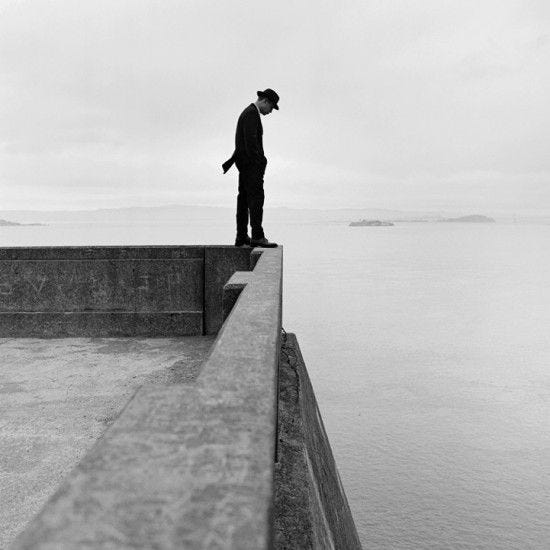
Faith as a leap, not a proof
Kierkegaard would nod at that. To him, truth was never an equation. It was not the result of reason but the trembling product of commitment. He described faith not as certainty, but as a leap into the absurd. Abraham, who was willing to sacrifice Isaac—not because it made sense, but because love demanded it.
We want guarantees. We want logic. But the spiritual life doesn’t offer those. It offers choice.
“Either/Or,” Kierkegaard titled one of his major works. Either live aesthetically—chasing pleasure, avoiding pain—or live ethically, embracing responsibility, sacrifice, the call of the eternal. But this choice, he warned, cannot be made intellectually. It must be lived. Suffered. Died for.
So too in Hesse’s world. The journey cannot be outsourced. The river must be sat beside. The wolf must be faced.
You must do it yourself. No one can become you for you.
A guide to the inner pilgrimage
No one teaches us how to live inwardly. School teaches us dates and decimals. Work teaches us to trade hours for money. But who teaches us how to return to ourselves?
Here is a map. Not a rulebook. Just a few soul-worn signs from those who have walked before.
1. Renounce without retreating
You do not need to flee to a monastery. The true renunciation is internal. Detach from noise. Create sacredness in the ordinary. Wash your dishes like a monk. Answer emails like a mystic. Be in the world—but not of it.
2. Walk with the question
Don’t rush to fix your doubt. Let it walk beside you. Kierkegaard said that doubt is not the opposite of faith—it is its origin. Faith begins when certainty dies.
3. Let contradiction be a teacher
You are both light and shadow. Saint and savage. Do not resolve this. Let it transform you. As Hesse wrote in Demian, “The bird fights its way out of the egg. The egg is the world. He who would be born must destroy a world.”
4. Find your sacred text
It might not be religious. It might be a novel, a poem, a song. But read it like scripture. Carry it with you. Let it speak when you cannot.
5. Seek the silence
Spend time alone, not just for productivity, but for presence. Not meditation as a trend, but as a return. A conversation with the part of you that does not speak in words.
6. Suffer meaningfully
Pain is not proof of failure. It is proof that you are alive. Let your suffering have shape. Let it carve out space for something real. As Kierkegaard wrote, “Only the person who has been in despair can become a true believer.”
The gift of inwardness
When you begin to walk this path, the world won’t understand. You will seem distant. Disconnected. You will be accused of overthinking, of being too intense, too sensitive, too strange.
You are not strange. You are returning.
And though it feels like solitude, you are not alone. Every mystic, poet, and pilgrim has walked this same road. They whisper through pages and prayers: You are on the right path. Keep going.
Eventually, something shifts. The ache is still there, but it is no longer hollow. It is holy.
You begin to see differently. Not because the world has changed—but because you have. You no longer need to grasp at things to feel alive. You carry aliveness within you. The joy is quieter now, but deeper. It does not depend on outcomes. It is not mood. It is being.
You Are the Journey
In Steppenwolf, Harry Haller reaches a door labeled MAGIC THEATER – FOR MADMEN ONLY – PRICE OF ADMISSION: YOUR MIND. That is this life. A strange, swirling magic theater of meaning and madness, of beauty and blood. The price of entry is everything you think you are.
But what you gain is beyond comprehension.
Kierkegaard reminds us: the self is not a thing to be discovered, but a task to be undertaken. You are not a noun. You are a verb. Not a fixed identity—but a becoming. An unfolding.
And Hesse would add: this unfolding is not linear. It spirals. It repeats. You may feel lost. You may feel like you’ve regressed. But even that is part of the rhythm. The spiral always leads inward.
Keep walking. The river awaits. The wolf is watching. The desert blooms when you stop trying to escape it.
You are not broken. You are being born.

I know this journey all too well. Continually letting old parts of myself go with gratitude for getting me to where I am today. It’s the dying / rebirth process, always in motion. We must surrender to change (which is the natural flow of life) if we are to uncover who we are. Thank you again for your introspection.
This is a beautiful post, thank you 🙏
I appreciate your comment about not needing to flee to a monastery. I think renunciation is often misunderstood. A wise man once said not to mistake disgust with true renunciation. Fleeing from society is often just spiritual excapism. Fattening up the same ego that we're attempting to transcend. It's an inner shift—there's no need to go anywhere.